
2010-01-29 13:00:00
Obstacles to an enterprise DVCS
On 26 January 2010 I gave a presentation to Software GR. The talk was an overview of several trends that we have seen in the version control tools market over the last 40 years. I often like to follow a talk like this by publishing the same content here on my blog in the form of a complete article. This time I think I'll just eliminate a lot of the tldr problem and summarize the highlights:
- The two big trends in version control today are Integration and Decentralization.
- Integration is driven by ALM. It is the desire to have all tools used by a development team fully integrated together.
- Decentralization is driven by the recent wave of DVCS tools like Git and Mercurial. They offer compelling benefits such as performance, a different kind of scalability, and more flexible workflows.
- The ALM trend is happening in the enterprise market. Enterprises want everything integrated with everything else, and they want everything to support their ability to enforce process.
- The DVCS trend is happening in the open source community. Born of the legendary cat fight between BitKeeper and the Linux kernel developers, Git and Mercurial are maturing and gathering momentum at a remarkable rate.
- These two trends are going to
clash in a big way. SourceGear's graphic designer drew me a nice diagram
to depict this.
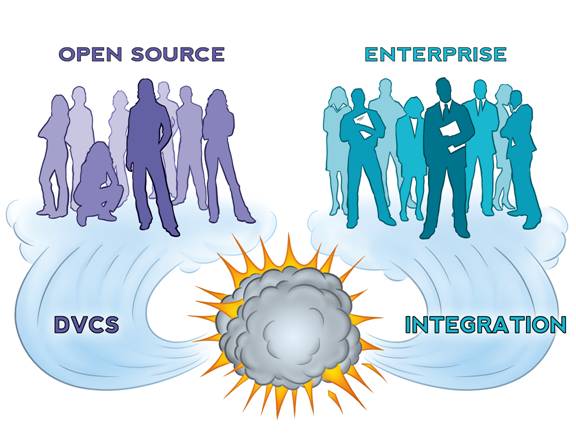
- The two trends cannot stay separate. Each one has advantages which are too important for the other community to ignore.
- But the two trends and their respective communities are a bit like oil and water.
- Enterprises want tools that constrain. The open source community wants tools that empower.
- The benefits of a DVCS would be diluted by integrating it with a bunch of other tools that are highly centralized.
- Enterprises need a least a little centralization for things like user administration. In their eyes, complete decentralization without accountability and auditing features is a bug.
- Even as enterprise attitudes about open source are changing, that change is happening slowly, and the GPL (used by both Git and Mercurial) is still considered the scariest license.
- So Git and Mercurial are not even close to being enterprise-ready. Similarly, none of the leading enterprise ALM tools are even close to being a DVCS.
- I believe that the main enterprise ALM providers (IBM/Rational, Microsoft, Serena and Borland) will all attempt to add DVCS features to their products. At least two of these companies (IBM/Rational, in a talk by Jean-Michel Lemieux at the Rational Conference in 2009, and Microsoft) have already made public remarks about a desire to move in that direction.
- And I predict that they will all fail. It is impossible to turn any of these systems into a true DVCS without a nearly complete rewrite. The D in DVCS is not a feature which can be added.
- But all of them will do it anyway, by making compromises. They will try to add "just enough" Decentralization. Some of their customers will find the results to be sufficient.
- Meanwhile, the true DVCS tools will continue to move forward, but their progress toward credible ALM will be slow. Enterprise-level integration is grunge work, not the kind of coding that hackers do as a labor of love. Nobody does this stuff without getting paid.
- So these two trends will continue to be distinct for a while, but the pressure and tension between them will remain, and the areas of overlap are going to continue getting messier.